
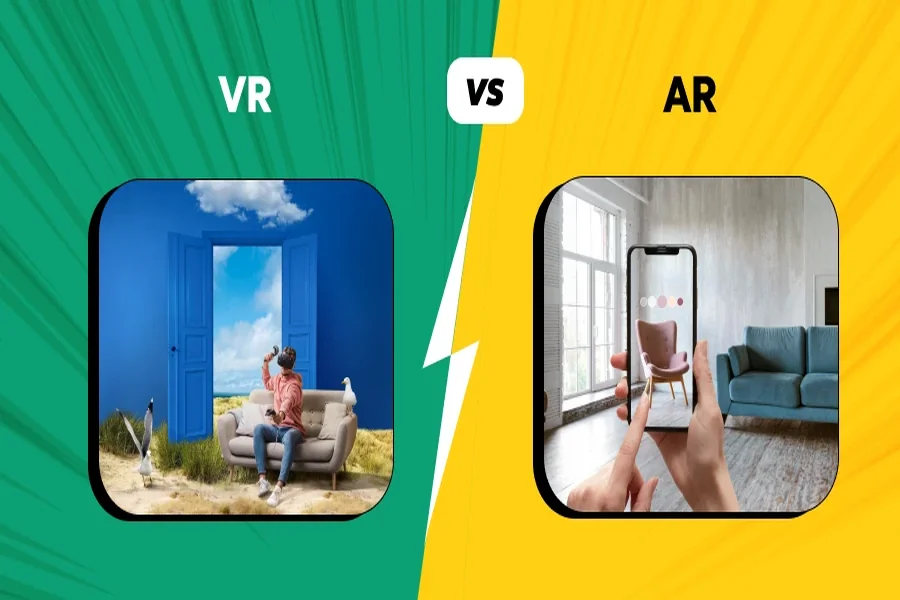
The difference between augmented and virtual reality often confuses people. Both technologies change how you see the world. But they do it in very different ways. One adds things to your real surroundings. The other replaces your real surroundings completely. This article will walk you through each technology step by step. You will learn how they work where they shine and which one might fit your life better. No technical background is needed. Just a curious mind.
Let us start with a simple mental picture. Imagine looking through a window. Augmented reality is like drawing on that window with colorful markers. You still see the trees and cars outside. But now you also see a cartoon bird or a helpful note written on the glass. Virtual reality is different. It pulls the curtains shut and turns the window into a movie screen. You no longer see the outside world. You are inside a new world entirely. That feeling is the core difference between augmented and virtual reality.
What Is Augmented Reality?
Augmented reality keeps you in the real world. It adds digital things on top of what you already see. These digital things can be images sounds or text. Your phone camera or special glasses capture your surroundings. Then a computer program places extra objects into that view. For example you might point your phone at a restaurant. The screen shows the building plus a floating menu. Or you wear smart glasses. While walking down the street you see direction arrows painted on the sidewalk.
The key idea is enhancement not replacement. You remain aware of real people real objects and real spaces. The digital layer simply gives you more information or more fun. Think of Pokémon GO. You walk through a park. Your phone shows the grass and trees. Then a Pikachu appears sitting on a bench. That is augmented reality. The real bench is still there. The digital character just joins the scene.
Augmented reality does not need expensive gear. Your smartphone works fine. Many apps use AR for shopping education or games. You can measure a room with your phone camera. You can see how a new sofa looks in your living room before buying it. You can even translate a foreign street sign instantly. The digital words replace the original text on your screen. But the real sign stays unchanged in front of you.
What Is Virtual Reality?
Virtual reality takes you somewhere else. It blocks out your actual surroundings. You wear a headset that covers your eyes and ears. Inside the headset you see a completely digital world. You might stand on a virtual mountain. You might swim with digital whales. You might sit in a virtual classroom. Everything you see belongs to the computer. Nothing from your real room enters your view.
VR tricks your brain. The headset shows two slightly different images one for each eye. This creates depth and makes the world feel solid. Motion sensors track your head movements. When you turn your head left the virtual world shifts left. When you look down you see your own digital hands or feet. Some systems include handheld controllers. These controllers let you grab throw or point at virtual objects. The goal is full immersion. You feel present in a place that does not physically exist.
Getting into VR requires more equipment. You need a headset like an Oculus or HTC Vive. Some headsets work with a gaming computer. Others like the Meta Quest work on their own. But you still need controllers and a clear space to move around. You cannot use VR well while walking down a real street. You would bump into things. So most VR experiences happen indoors in a safe room.
Key Differences Between Augmented and Virtual Reality
The difference between augmented and virtual reality comes down to reality versus replacement. Augmented reality adds to your existing reality. Virtual reality replaces your reality with a new one. That single distinction drives every other difference.
Your environment. With AR you see your actual living room your actual office or your actual sidewalk. Digital objects float inside that space. With VR you see none of that. Your living room disappears. You stand inside a digital forest or a virtual spaceship.
Equipment needed. AR works on many phones and tablets. No special headset required. You just open a camera app. Some AR glasses exist but they are not common yet. VR needs a headset at minimum. Often you also need controllers and sometimes a powerful computer. VR costs more money upfront.
Level of immersion. AR keeps you partly in the real world. You can still talk to people nearby. You can still watch for cars crossing the street. VR pulls your attention completely. You cannot see your dog walk into the room. You might trip over a toy left on the floor. That deep immersion is exciting but also isolating.
Interaction with real objects. In AR you can touch real things easily. You can pick up a cup while playing an AR game. In VR you cannot see real objects. You might knock over a lamp while swinging your arms. VR requires a clear safe play area.
Use cases. AR excels at quick information and practical help. Directions measurements translations and product previews all work great in AR. VR excels at full experiences. Training simulations virtual travel architectural walkthroughs and immersive games shine in VR.
Real World Applications of AR and VR
Both technologies have found homes in different industries. Let us look at how real people use each one every day.
Augmented reality in action. Retailers let you try on clothes using your phone camera. The digital shirt appears on your real body. Furniture stores let you place a virtual chair in your real room. Mechanics use AR glasses to see repair instructions overlaid on an engine. Doctors use AR to see a patient’s veins under the skin. Educators use AR to make textbooks come alive. Point your phone at a diagram of the heart. A 3D heart pops up beating on the page. Tourists use AR to see historical information about buildings they pass. Each application keeps the user grounded in their real location.
Virtual reality in action. Pilots practice flying in VR simulators before touching a real plane. Surgeons rehearse complex operations in VR. Architects walk through buildings that only exist as digital files. Students take virtual field trips to ancient Rome or the bottom of the ocean. Therapists treat phobias by exposing patients to virtual spiders or heights in a safe room. Athletes watch VR replays to study their form. Real estate agents offer virtual home tours without leaving the office. In each case the user leaves their real surroundings behind. They enter a controlled digital environment.
The difference between augmented and virtual reality becomes clear when you watch someone use each one. An AR user looks at the world through a screen. They smile at what they see. A VR user wears a closed headset. They swing their arms and gasp with surprise. One stays connected to here and now. The other travels to there and then.
Which Technology Is Right for You?
Choosing between AR and VR depends on what you want to do. Ask yourself a few simple questions.
Do you need to stay aware of your real surroundings? If yes then AR is safer and more practical. You can use AR while cooking while walking or while talking to family. VR demands your full attention. You cannot multitask in VR.
Do you want to escape from reality? If you feel stressed by your environment VR offers a complete break. You can relax on a virtual beach. You can explore a fantasy world. AR does not provide that level of escape because the real world stays visible.
What is your budget? AR basically costs nothing if you own a smartphone. Hundreds of free AR apps are available. VR requires a hundred to a thousand dollars for a headset. Plus you might need a gaming computer. That adds more cost.
What are your goals? For learning quick facts or seeing product previews choose AR. For practicing dangerous skills or experiencing impossible places choose VR. A firefighter can train for a burning building in VR without risk. A homeowner can see how paint colors look on their actual walls with AR.
Many people enjoy both. You might use AR to navigate a new city during the day. Then put on a VR headset at night to watch a movie on a virtual giant screen. Neither technology is better overall. They just serve different needs.
Final Thought
The difference between augmented and virtual reality will keep growing as both technologies advance. Soon AR glasses may become as common as smartphones. VR headsets may shrink into normal looking sunglasses. But the core difference will remain. AR will always anchor you in the physical world. VR will always offer you a ticket to a different one. Neither replaces the other. They are two tools for two different human desires. One desire is to understand our world better. The other desire is to step away from it for a while. Both desires are valid. Both technologies are gifts. Use AR to add magic to your Monday morning commute. Use VR to escape to a quiet forest on a noisy evening. Just remember which one you are wearing before you try to walk down a flight of stairs.
Frequently Asked Questions
What is the simplest way to remember the difference between augmented and virtual reality?
Think of AR as adding to reality and VR as replacing reality. AR says here is extra stuff. VR says forget where you are and look at this new place.
Can augmented reality and virtual reality work together?
Yes. Some advanced systems mix both. For example you might wear AR glasses that see your real room. Then a VR headset could project virtual furniture that stays in place when you walk around. But for most consumer products they remain separate.
Which one is more expensive?
VR is almost always more expensive. A decent VR headset costs at least two hundred dollars. High end VR systems go over one thousand dollars. AR is free on your phone. Professional AR glasses can be costly but most people use phone based AR.
Is augmented reality safer than virtual reality?
Generally yes. With AR you can still see obstacles people and traffic. With VR you are blind to the real world. That is why VR manufacturers warn you to clear your play area. People have punched walls or tripped over pets while in VR.
Can I use AR without the internet?
Many AR apps work offline. The phone processes the image on the device itself. But some features like loading 3D models may need a data connection. VR often requires an internet connection for downloading games or joining multiplayer sessions but single player VR can work offline too.
Which technology is older?
Both concepts appeared in the 1960s. But consumer AR became popular with smartphones around 2010. Consumer VR took off later around 2016 with the Oculus Rift and HTC Vive. So modern AR hit the mainstream a few years before modern VR.
Do I need special glasses for AR?
No. Your phone or tablet is enough. Just open the camera. Many apps will turn that camera view into an AR experience. Dedicated AR glasses exist like the Microsoft HoloLens but they are expensive and mostly used by businesses.
Can VR damage my eyes?
There is no proof that VR causes permanent damage. But some people experience eye strain or headaches after long sessions. Take breaks every thirty minutes. AR is gentler on your eyes because you still focus on real objects at normal distances.
Will one technology replace the other?
No. They serve different purposes. You will not use VR to check a price tag in a grocery store. You will not use AR to pretend you are flying over Mars. Both will evolve and find their own fans.
Which is better for education?
It depends on the subject. AR works well for labeling diagrams showing anatomy overlay or bringing a textbook image to life. VR works well for historical reenactments dangerous science experiments or exploring places students cannot visit in real life. The best classrooms use both.
